

In February 2015, the New York Attorney General’s office sent cease-and-desist letters to four major retailers: GNC, Walmart, Target, and Walgreens [1]. The order told them to pull store-brand herbal supplements from shelves. The evidence behind it looked overwhelming. Investigators ran 390 DNA tests on products containing echinacea, ginseng, St. John’s wort, garlic, ginkgo biloba, and saw palmetto. The main headline revealed a stark takeaway. Only 21% of test results confirmed that the DNA matched the ingredient data listed on the product label. Walmart’s products fared the worst, with just 4% of tested samples showing a match.
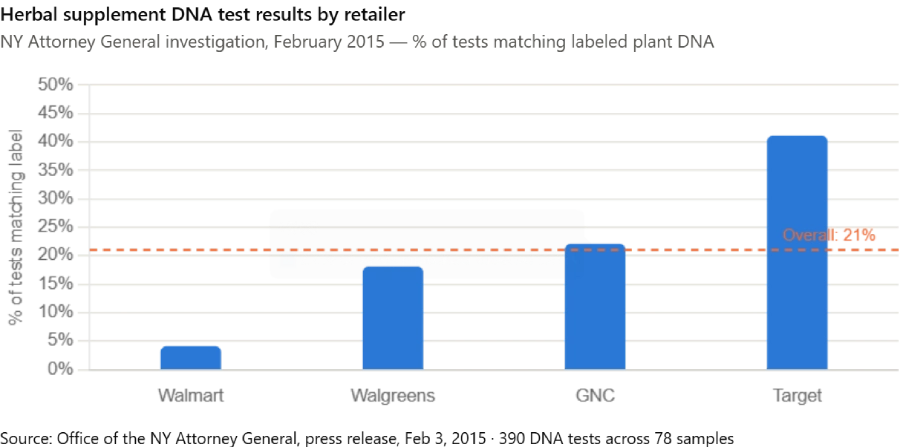
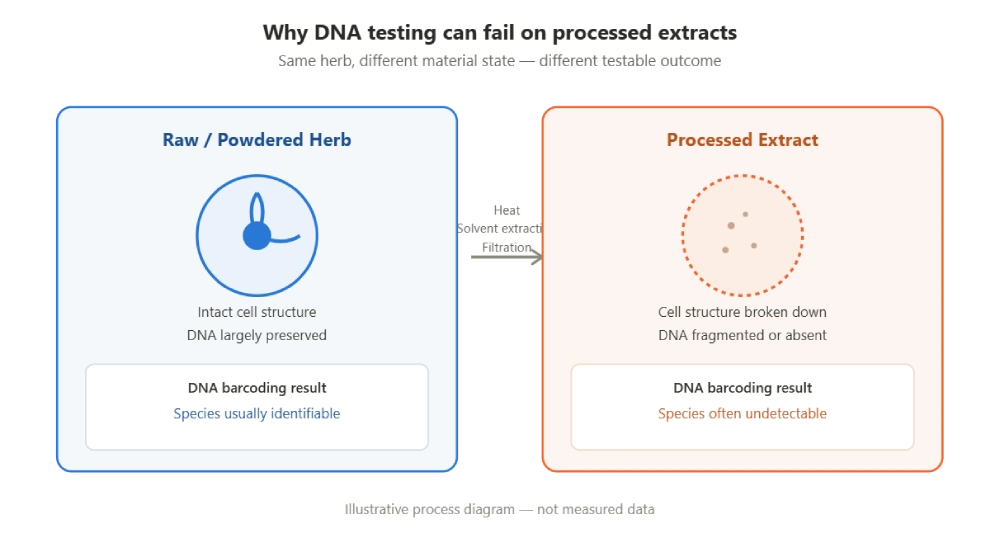
At first glance, this appeared to be a comprehensive and rigorous dataset. But within weeks, a group of analytical chemists, botanical scientists and industry bodies pushed back hard [2]. The American Botanical Council, the American Herbal Products Association, and independent testing labs all raised the same objection [2]. The flaw lay not in laboratory execution, but in applying DNA barcoding to a product matrix for which it was fundamentally unsuited. Processing herbal supplements through heat, solvent extraction, and filtration degrades genetic material, meaning the analytical validation approach was mismatched from the start. Without proper botanical authentication protocols that account for processing states, looking for intact DNA in a refined extract yields misleading conclusions.
GNC said exactly this: its tested products were extracts, not raw or powdered herb. Nearly a decade later, in 2024, the underlying scientific paper that had originally prompted the investigation was formally retracted by its publishing journal, after evidence of data fabrication was discovered [3] — a stronger resolution than a debate that simply faded from headlines.
Nothing about the 390 results was fabricated:
- The testing was real
- The lab work was real
- The percentages were real.
What was actually in dispute was simpler: could this analytical validation method yield reliable ingredient data to answer the question being asked of it? The method and the material may not have matched.
This is the failure mode worth understanding before your business runs its next round of testing or literature review. A large, accurate dataset can still produce the wrong answer. That happens when the measurement was never capable of capturing valid ingredient data for that specific material.
When more ingredient testing actually reduces uncertainty
This isn’t an argument against testing or documentation. More evidence closes real gaps in plenty of situations. Regulatory compliance is one example. A missing certificate of analysis or an unverified allergen statement poses a genuine compliance risk that justifies thorough verification. Qualifying a brand-new supplier is another. Before any track record exists, collecting multi-dimensional ingredient data is genuinely useful.. Even in the New York case, the lesson experts drew afterward wasn’t “test less.” It was “match the method to the material.” Several labs and industry groups later published guidance recommending DNA barcoding be paired with chemical fingerprinting methods like HPLC or TLC. Each method can confirm what the other cannot.
The mechanism: why volume and validity are different variables
The reason additional data fails to improve decision-making is straightforward. New evidence helps when it can actually answer the question in front of you. Once that capability is missing, more evidence doesn’t fix the problem. It just produces a more confident-looking version of the same wrong answer. Three hundred and ninety tests carry more apparent authority than thirty. But if the method-to-material mismatch exists in one test, it exists in all 390. Running more tests doesn’t correct the mismatch. It multiplies it. This is why incorporating digital intelligence into quality assurance workflows is becoming essential: automated checks can flag when an analytical validation framework is unsuited for a given material before millions of dollars are lost in public disputes over ingredient data.
📎 Also worth reading: Your Botanical Specification Passed. Your Product Still Failed.
Correct numbers, different materials: the sea-buckthorn example
This analytical failure also occurs in everyday commercial settings without regulatory intervention. It happens simply by comparing two things that share a name but not a composition. Sea buckthorn (Hippophae rhamnoides) is a clear example. A peer-reviewed study of Canadian-grown cultivars found seed oil containing linoleic acid at 33–36% and α-linolenic acid at 30–36% of total fatty acids. Pulp oil from the same berries told a different story: palmitoleic acid at 32–42%. The fatty-acid profile depends heavily on which part of the fruit the oil came from [4].
Even with one material, the processing method can change what the commercial ingredient actually contains. A separate 2021 study looked at sea buckthorn leaf powders. It found that phenolic and triterpenic composition varied by cultivar. Similarly, Drying method affected antioxidant activity and color, but not the underlying chemical profile [5].
None of these numbers contradict each other. They simply describe three different materials: seed oil, pulp oil and leaf. Each has its own compositional identity. Before comparing a competitor’s sea buckthorn specification with their own, a buyer must first confirm one critical variable: which plant fraction does each number actually describe? None of these numbers contradict each other; they simply describe three different materials: seed oil, pulp oil, and leaf. Each has its own unique compositional identity. Without that check, a real compositional difference can look like a non-existent quality gap—or a genuine discrepancy can go entirely unnoticed.
The practical rule that follows is straightforward: before judging whether a number is high or low, check whether the benchmark used to interpret it actually belongs to the same material being evaluated. A botanical specification can be scientifically valid and still be the wrong reference point. This is true well beyond sea buckthorn — a pomegranate whole-fruit powder isn’t equivalent to a peel extract, a walnut oil answers different formulation questions than a walnut kernel powder.

Even within one material, processing method (as shown in research on sea buckthorn leaf powders, where cultivar and drying method both shifted phytochemical and antioxidant profiles) can change what the commercial ingredient actually contains. Without evaluating the raw testing output against a matched reference standard—using precise tools like HPLC—a real compositional difference can look like a non-existent quality gap. Material definition has to come before benchmarking, not after it.
Before asking whether a number is high or low, ask whether the reference used to interpret it actually belongs to the same material.
The reviewer’s checklist before your next ingredient test
Both cases point to the same short list of questions. Ask them of any C-of-A data, specification or study before treating it as decisive.
- If a test finding were confirmed as accurate, what specific action would follow?
This is a different question from whether a wrong result matters — it asks what happens once a result is validated as correct. A confirmed compositional gap might justify a new supplier audit, a revised specification, or an updated technical data sheet. If confirming the finding wouldn’t change anything currently being done, it may still be worth recording, but it doesn’t need to be treated as urgent.
- What does an ingredient test result actually establish?
A method name alone isn’t enough — “HPLC/UV: Complies” on a certificate of analysis tells you an instrument was used, not which active compound were quantified. Achieving robust botanical authentication requires verifying the underlying raw dataset against verified baseline specs. Curcuminoid content in a turmeric extract, for example, can be reported as one combined percentage or broken into three individual curcuminoids — two numbers that look comparable but answer different questions.
- Does the analytical method actually work for the material state being tested — raw, powdered or extracted?
DNA barcoding identifies plant species by matching genetic material, and it works reliably on raw or powdered herb, where cell structure remains intact. It becomes unreliable on processed extracts, because heat and solvent extraction degrade or destroy plant DNA during manufacturing — a gap that came to public attention in 2015, when a U.S. state investigation applied DNA testing to herbal supplement extracts and reached conclusions later challenged by analytical chemists on exactly this basis. The same caution applies to spectrophotometric assays run on concentrated extracts versus whole-plant material, where concentration alone can shift a reading independent of actual compound identity.
- Can an analytical finding be confirmed by a second, independent test method?
A single test result, however precise, is a single point of failure. Pairing DNA barcoding with a chemical fingerprinting method such as HPLC or TLC works because each one confirms what the other cannot — DNA identifies species, chemical fingerprinting quantifies compound presence regardless of DNA integrity. One method flagging a result is a reason to investigate further; two independent methods agreeing is what actually justifies a business decision.
- Does the reference point used for comparison match the same plant fraction, processing state and origin as the material being evaluated?
A seed-oil fatty acid profile is not a valid benchmark for a pulp-oil specification, even when both are labeled with the same ingredient name. The same logic applies to comparing a whole-fruit powder against a peel extract, or a cultivar grown in one region against a pharmacopeial reference range built from material grown elsewhere.
- If a test result turned out to be wrong, would it actually change a real business decision?
Does it dictate a supplier switch, a specification revision, or a label claim? Or is the finding merely an interesting datapoint without immediate commercial consequence? A small shift in a minor trace compound rarely changes a formulation choice; the same shift in an actively marketed active ingredient usually does.
Explore a Full Ingredient Intelligence Investigation →
The commercial stakes of a mismatched test method
The New York case shows the cost clearly. Four major retailers pulled products from shelves nationwide. They absorbed reputational damage in national press coverage. They spent months in a public dispute over testing methodology. A properly matched test method might have avoided that cost, or reduced it early. Smaller ingredient businesses face the same failure mode, just at a smaller scale:
- Technical review cycles stall over numbers that were never comparable.
- Supplier disputes get built on a botanical specification mismatch nobody named.
- A customer-facing claim gets built on a study that measured the wrong material.
What’s less obvious is what a business gains by catching this before a regulator or customer does. Harnessing reliable ingredient data and digital intelligence allows a technical team to audit C-of-A data efficiently and confirm that their chemical fingerprinting method actually matches the material matrix. That proof creates a stronger negotiating and defensive position. A competitor relying on a single, unchecked certificate doesn’t have that advantage.
The practical takeaway
Before you request another COA, commission another test, or cite another study, ask one question first. Is this specific evidence actually capable of answering the specific question in front of you? Check the material. Check the method. Ask whether the decision would really change if the number came back different. The New York case didn’t fail because 390 tests were too many. It became contested because no one confirmed, before running them, that DNA barcoding could give valid ingredient data for these specific products..
Sources and further reading
- Sources: NY Attorney General press release, February 3, 2015
- Harbaugh Reynaud, D.T., Mishler, B.D., Neal-Kababick, J., Brown, P.N. “The Capabilities and Limitations of DNA Barcoding of Dietary Supplements.” White paper commissioned by AHPA, CHPA, CRN, and UNPA, March 2015. Summarized in HerbalGram HerbClip, American Botanical Council. herbalgram.org
- New Hope Network. “DNA Study That Sparked 2015 New York Attorney General Action Gets Retracted.” July 2024. newhope.com
- Fatima, T., Snyder, C.L., Schroeder, W.R., Cram, D., Datla, R., et al. “Fatty Acid Composition of Developing Sea Buckthorn (Hippophae rhamnoides L.) Berry and the Transcriptome of the Mature Seed.” PLOS ONE 7(4): e34099, 2012. DOI: 10.1371/journal.pone.0034099
- Raudone, L., Puzerytė, V., Vilkickytė, G., Niekytė, A., Lanauskas, J., Viskelis, J., Viskelis, P. “Sea Buckthorn Leaf Powders: The Impact of Cultivar and Drying Mode on Antioxidant, Phytochemical, and Chromatic Profile of Valuable Resource.” Molecules 26(16): 4765, 2021. DOI: 10.3390/molecules26164765
EyryDigital provides this exact layer of technical translation—aligning analytical evidence with business decisions—to support QA/QC and commercial teams